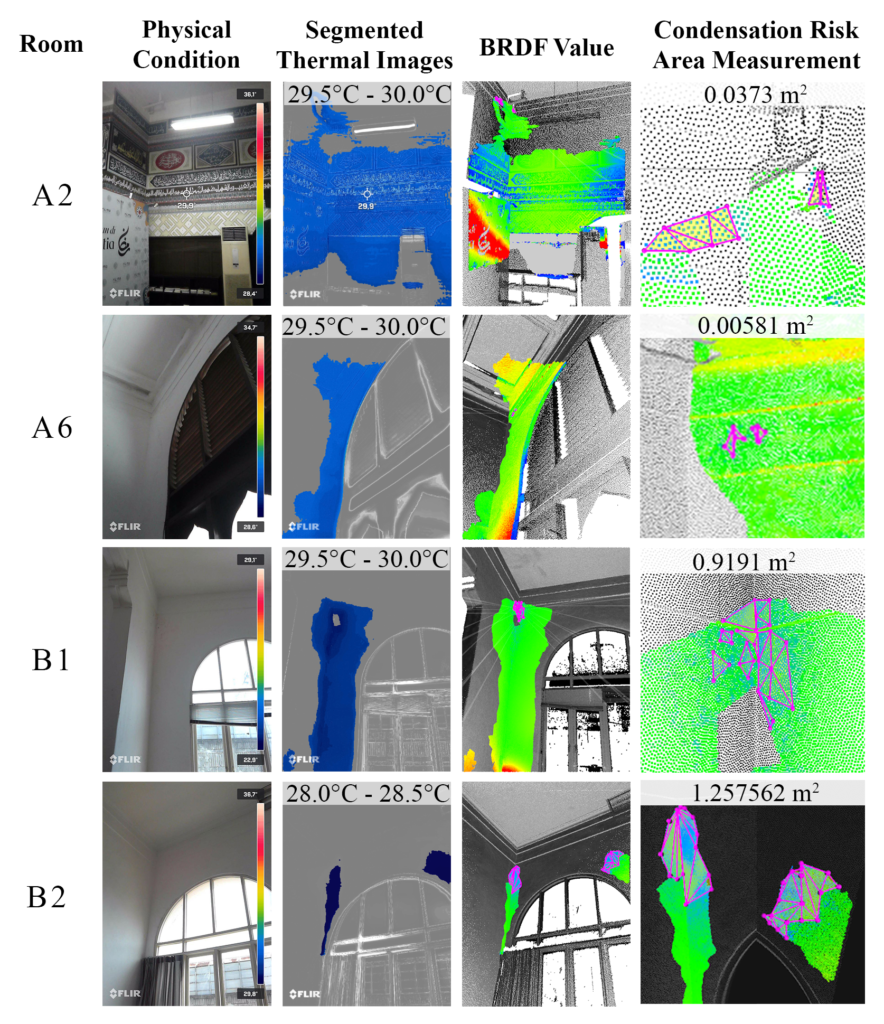
Cultural heritage buildings as an asset to the wealth and cultural identity of a nation pose a serious threat if they are located in areas with high levels of humidity, such as Indonesia. High humidity levels create moisture that causes condensation, increased humidity, and soil dampness. Maintaining humidity in order to preserve heritage buildings needs measurement devices with several conditions, such as non destructive methods and accessible for architects and conservationists. A number of studies have made efforts to detect the moisture within building surfaces. However, previous research was still limited to physical measurements using devices that took a long time or non-destructive methods that were complicated for architects or environmental conservationists. A device has emerged to accurately capture the condition of existing buildings, namely laser scanning technology which produces point cloud data. Point clouds store some information, such as geometric and radiometric information (i.e. XYZ, RGB, Intensity) which can then be used to calculate material properties on the surface of historic buildings. Therefore, this study proposes an integrated computational method to detect condensation risk in heritage buildings by utilising the geometric and radiometric information. The information represents the optical and thermal properties calculated from point cloud data, specifically Bidirectional Reflectance Function (BRDF) and surface temperature of surface material. The proposed method specifically uses the Blinn-Phong BRDF model to calculate the distributed reflectance in a material based on the incident angle and reflectance of the material. The investigation took place at the Cut Meutia Mosque, a cultural heritage building built around 1912. After carrying out several procedures and considering building code standards for condensation, the results showed that four rooms in the Cut Meutia Mosque had the possibility of condensation occurring. The risk area for condensation on the first floor is 0.49 & 1.77 m2, while on the second floor it is 0.216 & 2.051 m2 located in the corner of the room. Ultimately, this research provides architects with a better understanding of the potential danger of destruction from condensation on historic building surfaces, enabling them to carry out early risk detection procedures before damage actually occurs.
This research is funded by the Directorate of Research and Development, Universitas Indonesia under Hibah PUTI Q1 batch 1 2023 (Grant no. NKB-526/UN2.RST/HKP.05.00/2023)