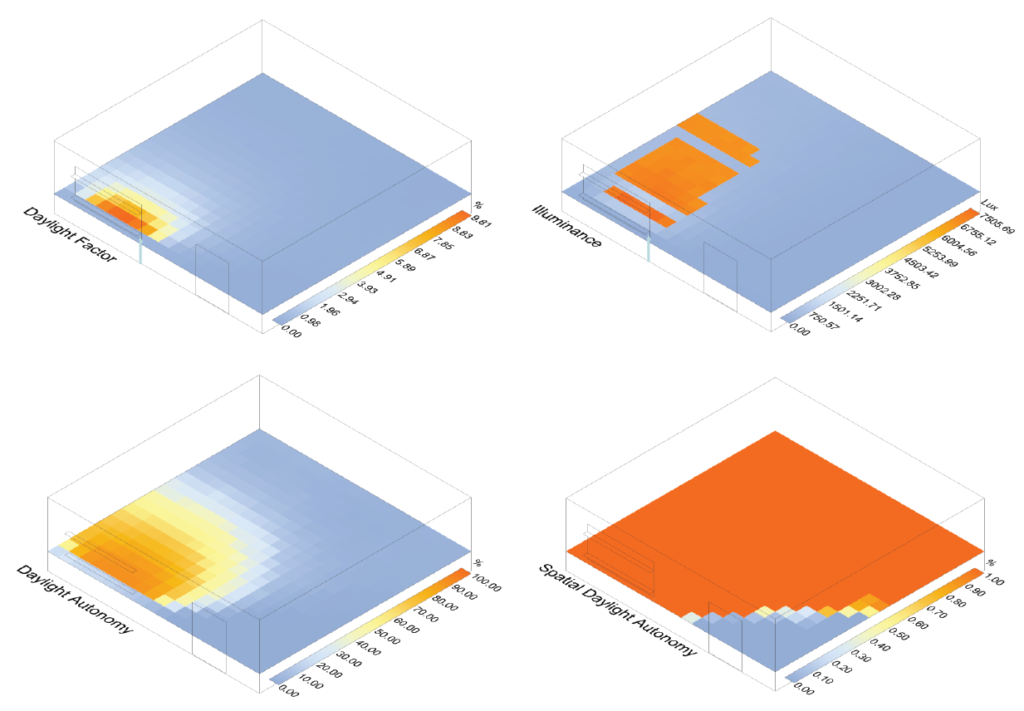
BPS stands for Building Performance Simulation. This is the first post in a series about BPS basics, aimed at architectural practitioners, academics, and students who want to simulate fundamental performance in a room or building. BPS basics are divided into three parts: Daylight, Thermal, and Energy. This course series was inspired by Honeybee Analysis from TOI-pedia TU Delft. In this series, Daylight is the first performance to simulate before Thermal or Energy, as it introduces the Honeybee workflows more straightforwardly.
Daylight plays a significant role in promoting human health and reducing energy consumption. By considering daylight in the early stages of the design process, architects and designers can optimize the building’s orientation, window placement, and shading systems, among other design decisions. Prioritizing natural daylight in the design process can result in a more sustainable, healthy, and visually appealing building for its occupants. Therefore, conducting daylight analysis early in the building design process is essential. The parameters required for the daylight simulation are
- Material properties
- Sensor grid
- Weather data
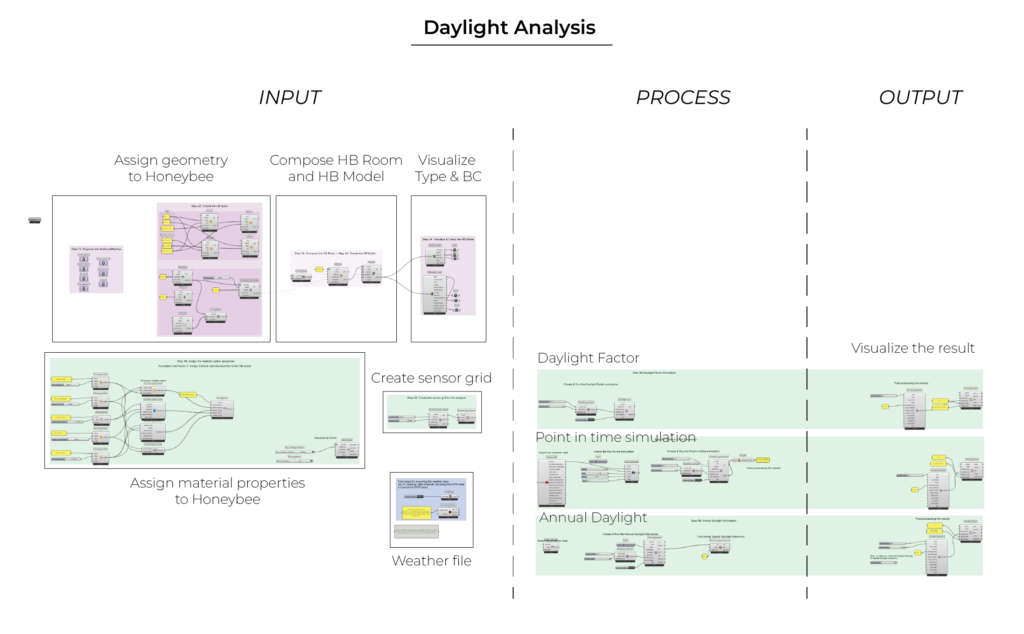
Daylight simulation was conducted using Grasshopper and its Honeybee plugin, which uses Radiance to run simulations. Daylight analysis provides several results, including the daylight factor, point-in-time simulation, and annual daylight analysis. The daylight factor measures the ratio of the light level inside a room to the light level outside the room. Point-in-time simulation is useful for investigating illuminance or luminance at a specific time, date, and year, and can also provide glare analysis with luminance simulation. Annual daylight simulation provides metrics for an entire year, such as Daylight Autonomy, Spatial Daylight Autonomy, and Useful Daylight Illuminance. This information can be used to develop the geometry of windows and shading, interior settings, and control of artificial lighting.