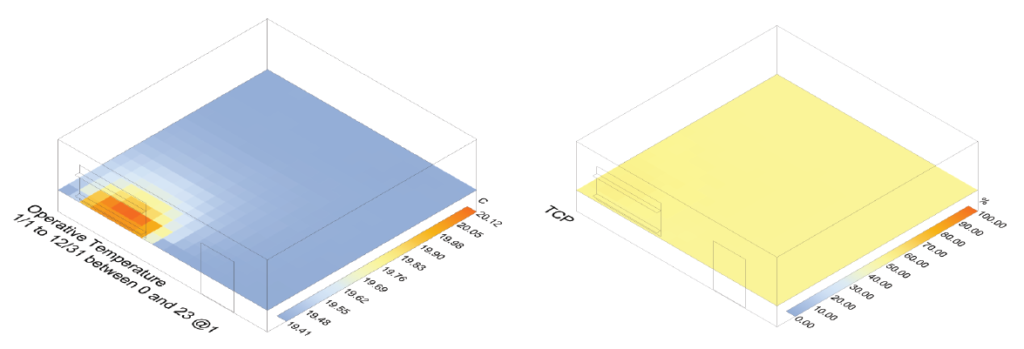
Thermal analysis is a crucial part of building performance simulation that helps architects and engineers optimize the thermal comfort, energy efficiency, and environmental impact of buildings. Thermal analysis simulates the heat transfer processes in buildings, taking into account factors such as solar radiation, convection, conduction, and ventilation. By analyzing the thermal behavior of buildings, designers can make informed decisions about the building’s form, materials, insulation, HVAC system, and other elements that affect energy use and indoor comfort. Thus, it is crucial to perform thermal analysis during the initial phases of building design. The parameters required for the thermal simulation are:
- Material properties
- Schedule set and energy loads
- Weather data
- Operable window setting
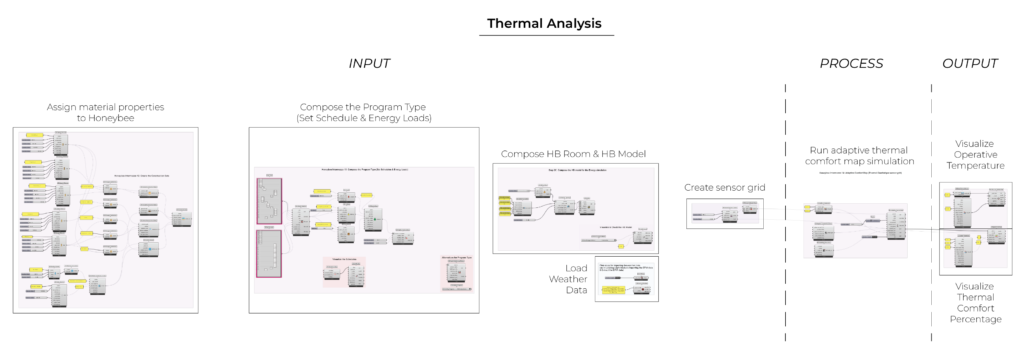
The digital tool Grasshopper, together with its Honeybee plugin, was used to perform thermal simulation. Honeybee employs OpenStudio to execute the simulation, which can generate adaptive thermal comfort maps with various indicators and metrics. The simulation indicators are Operative Temperature and Thermal Matrix. Operative temperature considers the mean air and mean radiant temperatures to determine the thermal comfort level. The Thermal Matrix shows the thermal state of each sensor grid in a room. The provided metrics are Thermal Comfort Percentage (TCP), Heating Sensation Percentage (HSP), and Cooling Sensation Percentage (CSP). TCP indicates the optimal thermal conditions in percentage-based units. HSP identifies the sensor grid experiencing undesirable heat in a room, whereas CSP identifies the undesirable cold. This information can be used to improve the thermal performance of a building through the development of windows, shading variations, and material layers.