Funders: Faculty of Engineering, UI
Year : 2024
Quantity: IDR 50.000.000
Miktha Farid Alkadri, Khusnul Fuadah, Heidy Sekardini, Alya Widha Aurellia
Product Description
Blooming Breeze explores the reverse engineering of traditional breeze blocks to enhance their performance through ecological and architectural innovation. This project dissects the material, structural, and environmental logic behind vernacular ventilation blocks, reinterpreting them using parametric design and environmental simulation. The resulting prototypes are designed not only to optimize airflow and daylighting but also to incorporate ecological functions such as air purification, habitat support, or water filtration. By blending aesthetics with sustainability, Blooming Breeze proposes a new generation of climate-responsive façade elements that respond dynamically to tropical urban conditions.
Product Development

- Initial Study & Reverse Engineering
Documentation and analysis were conducted on various types of local breeze blocks, including dimensional measurements, material composition, and geometric patterns. This stage provided a comprehensive understanding of the working principles and limitations of traditional designs.

- Parametric Exploration & Performance Simulation
Using Grasshopper and environmental simulation tools (such as Ladybug & Honeybee), multiple design variations were developed, driven by parameters responsive to cross-ventilation, light penetration, and ecological enhancement. These simulations guided the refinement of block geometry to maximize environmental performance.

- Prototype Fabrication & Testing
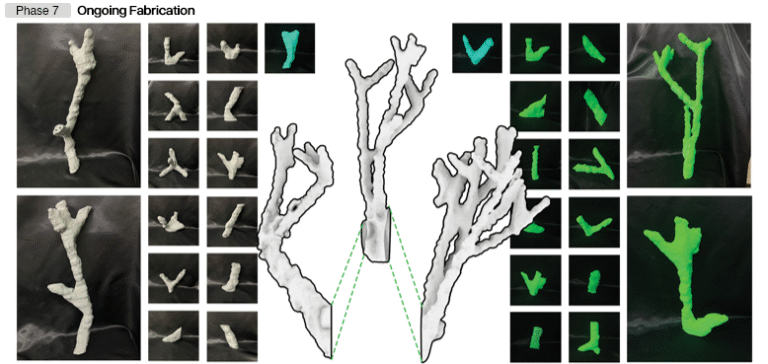
Selected designs were fabricated using 3D printing and casting techniques to test structural integrity, airflow performance, and ecological integration. Prototypes were evaluated under controlled conditions to assess their effectiveness in real-world scenarios. - Design Iteration & System Integration
Feedback from testing informed further design iterations, focusing on modular compatibility, assembly ease, and adaptability to different facade configurations. The final product aims to serve as a sustainable, multifunctional building element suitable for urban tropical contexts.